

Crisp, rain-soaked leaves in the morning. Fresh, salt-tinged air that clings to your skin after a day at the beach. For Metro Manila-based perfume brand Guava Smells, these fleeting moments are where fragrance begins. Each scent is hand-poured, guided by instinct, and subtly shaped by memory — built on feeling rather than formality.
EnVi caught up with founding duo Ryan Danao and Noelle D. Lejano ahead of their first anniversary pop-up to explore how curiosity, nostalgia, and a shared hobby evolved into a brand crafting full-bodied fragrances.
On Following Their Noses: Crafting Fragrance by Instinct
What does it mean to follow your nose? To truly be attuned to the scents around us and to capture that essence in a bottle? For Ryan and Noelle, that question became the quiet foundation of their work with Guava Smells — one that quietly pushes back against the idea that fragrance should be reserved for special occasions, instead encouraging it to be worn, felt, and lived in. “We’re people who like to take a bath in our perfume, spray it everywhere, and not feel bad about it,” Noelle said. “If I spend so much money on it, I feel bad [using it].” This mindset of using fragrance generously rather than sparingly, sets the tone for their approach, where scent is made and meant to be lived in daily, not rationed or reserved.
On December 13, Guava Smells celebrated its first anniversary at the Atrium in Makati, a repurposed Brutalist building now home to a growing community of Manila’s emerging independent brands. Inviting, open, and unpretentious, the space mirrored the same tactile, careful attention that defines each release. In Manila’s growing ecosystem of homegrown brands, they sit comfortably among makers who prioritize process over prestige.
The brand began at Danao’s home on Guava Street — where the name itself started as a joke before sticking. With no formal training to guide them, Ryan and Noelle relied on curiosity and instinct over ambition. Perfumery began as a joint pastime, rather than a business idea.
“For us, it always starts with a vibe,” Noelle admitted. “What do I want to feel like when I’m wearing this? What do I want other people to feel when they smell it?”
The idea also grew from family influence. Noelle’s mother (a maker of perfumes, candles, and other crafts) had been gifting Ryan with personalized blends long before the brand existed. She taught the couple the basics of perfume and helped them find suppliers whilst choosing to stay largely behind the scenes.
“Ryan and I really brought the business to the level it is now,” Noelle said. “But on the side, [we] also just wanted an excuse to hang out.” This informality also shapes a process that feels collaborative and low-pressure as opposed to one driven by industry expectations or rapid scale.
When the couple began, neither identified as perfumers or “fragrance heads,” but what they lacked in credentials, they made up for with intention. The scents they wanted to wear were either too expensive to use freely, too generic to feel personal, or simply didn’t exist in the local market. As consumers, they felt alienated by the options available to them, which were often imported, costly, and treated more as objects to preserve than wear daily. Their outsider perspective became an advantage of sorts, allowing them to approach fragrance not as collectors or experts, but as everyday users filling the gap in the local market.
Ryan remembers his favorite cologne in high school that cost several thousand pesos, far more than he could justify spending regularly. “When I tried to search around the area, or stores nearby or online in the Philippines for fragrance brands, there weren’t many for men at the time,” he observes. While doing research for their own line, he noted, “My friends, family, and everyone uses international brands. So I was like, do we not have a locally-grown one?”
From Curiosity to Creation
As the business grew, their roles took shape naturally. Noelle leads the creative and aesthetic direction — from shaping each scent’s mood, the brand’s visual identity, marketing, and social presence — while Ryan manages operations, finances, and the day-to-day flow of orders. That balance allows them to remain hands-on while ensuring quality and consistency.
Early experiments came with plenty of trial and error: melted bottle caps, hazy batches, and unexpected blends, with each mistake becoming a lesson. “We’re really figuring it out as we go,” Noelle noted. “A lot of trial and error — a lot of error.” Still, they keep their process small and personal. Each batch is mixed by hand, liter by liter, with careful attention to how the ingredients come together.
For Ryan, this choice is both practical and personal. “We want to make sure the quality is up there,” he explained. “We know all the ingredients that are put in, and there’s nothing that can be harmful to our customers or that feels cheap, while still making it an affordable price range.”
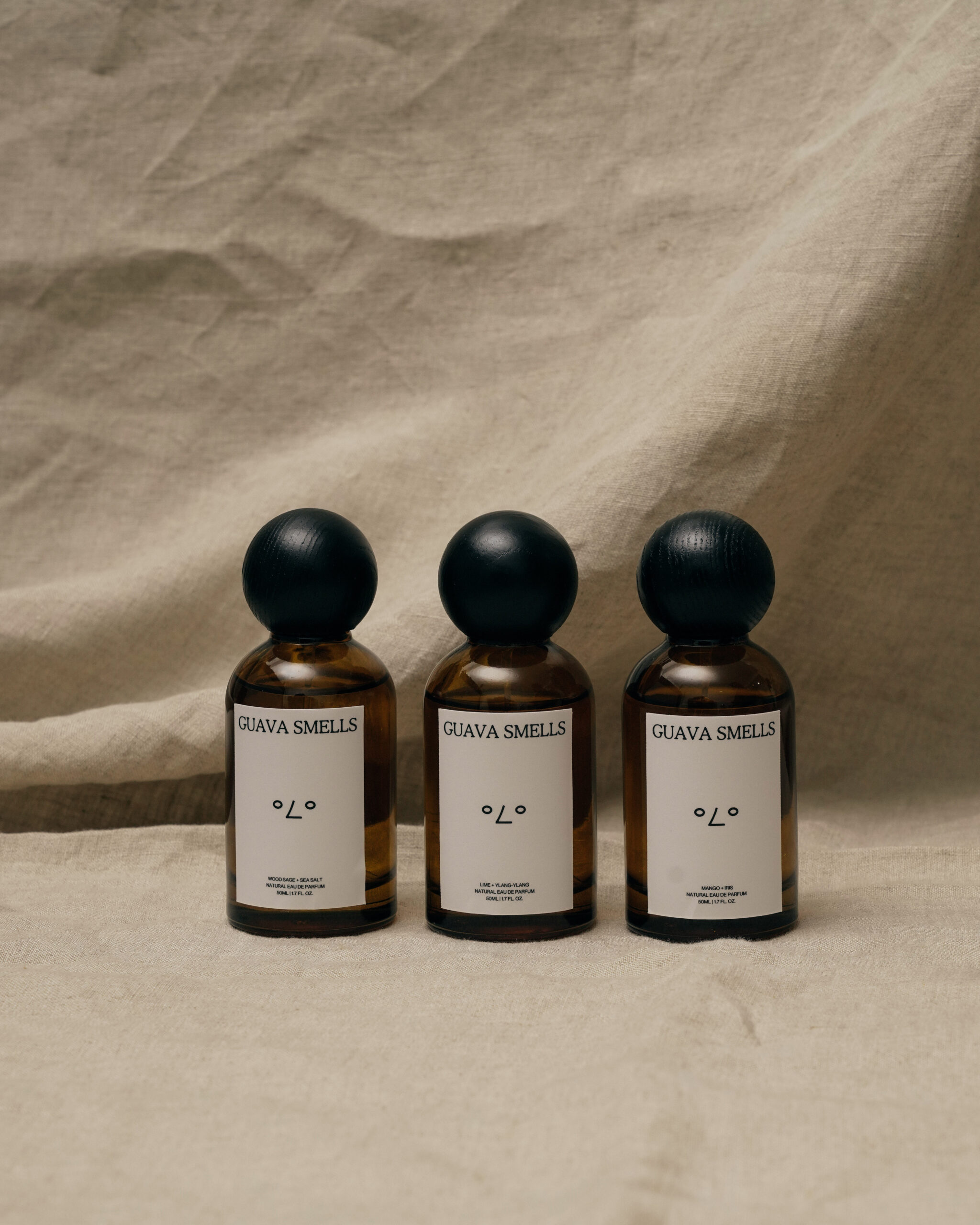
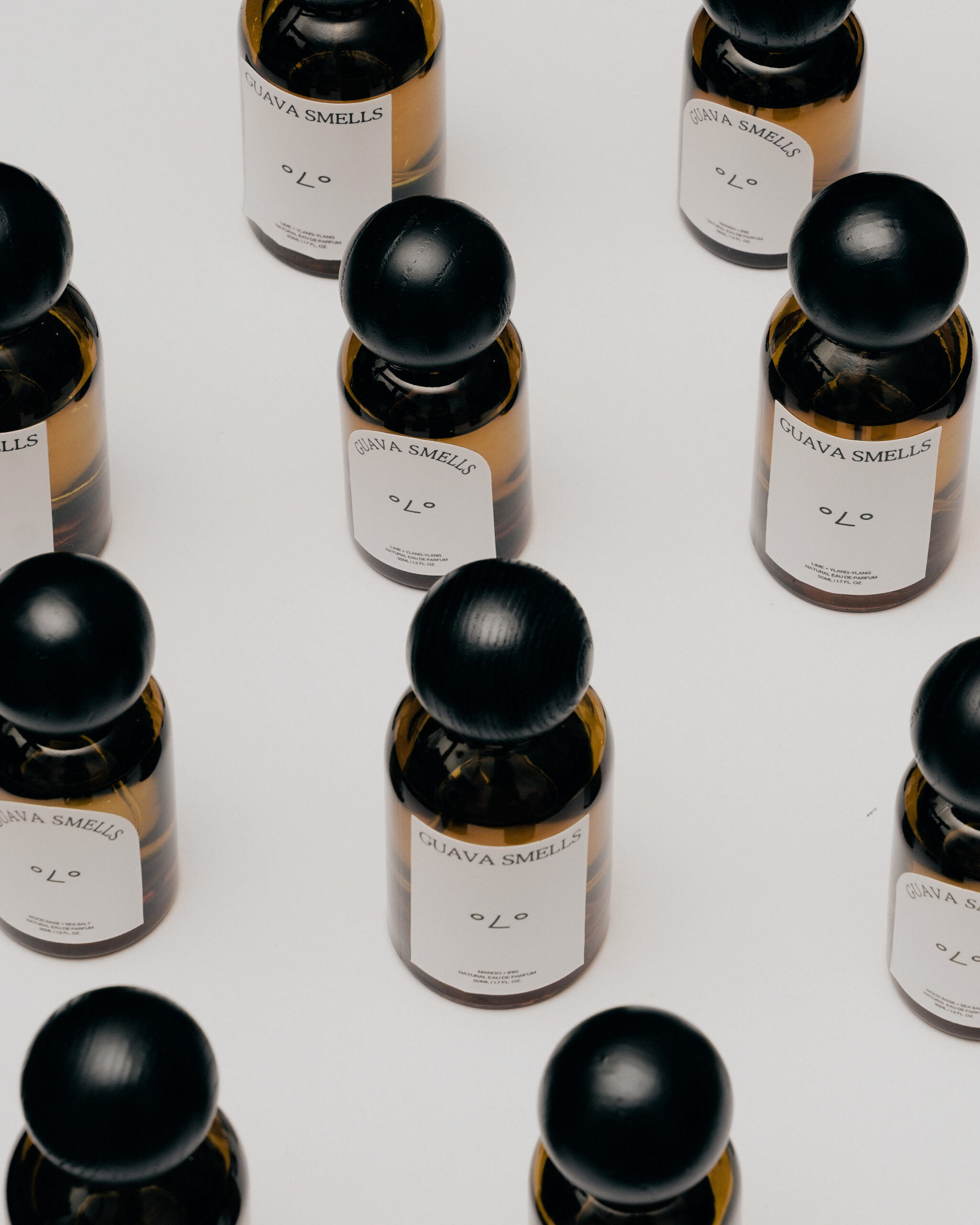
Today, Guava Smells’ perfumes range from ₱550 to ₱750, with room sprays priced at ₱650, positioning full-bodied fragrance as an everyday luxury rather than an inaccessible indulgence.
The Stories Behind the Scents
Over time, customers began noticing unique, recurring notes: local Filipino citrus, woods, and oceanic elements. “Subconsciously, that’s us being tied as Filipinos,” Noelle explained. Rather than explicitly referencing places, their scents pull from lived experience, allowing local familiarity to surface organically. “We go into scent experimentation [with] no agenda. It’s just trial and error of what we enjoy, what we don’t. Eventually, things that are familiar and comforting come out. It felt natural to us.”
Each of their scents begins with “a mood,” a feeling they want it to evoke, in place of formulas or trends. This philosophy shaped their bestselling perfume, Grapefruit and Cashmere, born from Noelle’s search for a musky yet lightly feminine scent “like a second skin” that couldn’t be found locally. Instead of waiting for someone else to create it, she and Ryan crafted it themselves, learning and experimenting along the way. This very mix of personal storytelling and resourcefulness is exactly what draws customers in, making each fragrance feel intimately theirs.
Lime and Ylang-Ylang, one of their citrus-forward scents, reminds Noelle of stepping outside after an overnight rain. “That’s what my house smells like in the morning,” she remarked. Another scent, Rosewood and Soft Suede, has prompted deeply personal reactions. “Someone told me, ‘My mom would love this. It smells like a rosary,’” Noelle recalls. “And she bought it, because it was familiar, it was comforting. That’s so special.”
Through messages from buyers and at pop-ups, these moments happen often. Customers connect with specific scents and share stories about parents, partners, or places they miss. “More often than not, they’re reminded of people,” Noelle reflected. “It’s just so sweet to hear, everyone has their own story just from something we made behind our own story. Whatever scent that we put out, when they smell it, when they tie a memory to it, it becomes theirs.”
Newer products, like room sprays, are designed with intention and ritual in mind. Lavender, for instance, is tied to rest and care. “My mom would spray lavender before we slept,” Noelle mentioned, while Ryan’s nostalgia stems from the familiar scent lingering in his mother’s old spa. These memories inspired the formulation of their Lavender and White Nectar room spray, bringing the same sense of calm and comfort into customers’ homes.


On Building a Brand for Everyone: What Inclusivity Means to Guava Smells
One of the brand’s hallmarks is its refusal to label scents by gender, with all their fragrances marked as unisex. Their approach reflects a broader shift among younger Filipino brands — away from rigid categories and toward self-definition.
“We want to be able to cater to everyone, for everyone to feel comfortable to use our scents,” Ryan explained. Clients often ask, “Is that scent for girls?” His response: “No, I wear that every day.” Noelle adds, “Then they’re like, ‘Okay, I’m happy with that, I’m gonna get that.’” That openness has resonated with customers, giving them the freedom to wear what feels fitting, without constraint.
“Instead of us labeling scents ‘for female or male,’ we allow the customer to identify for themselves — [to say] this is me, this is what I like,” Noelle shared, “In that way, we’re also able to let people explore their own identity, making them comfortable with that idea that they can be comfortable with what you like and who you are.”
Affordability plays a similar role in the brand’s ethos of inclusivity. In a country where luxury is too often inaccessible, Guava Smells positions fragrance not as an indulgence reserved for a few, but as something anyone can experience daily.
“Here in the Philippines, your perfume or your cologne is probably the last thing that families think about,” Ryan observed. “But we want to be able to have them experience this at something that doesn’t cost them so much, something that’s also of quality.”
Growing with Confidence, One Scent at a Time
Their intentionality hasn’t erased the insecurities that come with building a brand. Both Ryan and Noelle struggled with imposter syndrome, especially in moments when they’re expected to demonstrate expertise.
Selling in person quickly taught them to read customers carefully. “When they ask for recommendations, or they come up to us and say ‘I don’t know which one I want,’ we’re challenged with storytelling and having to explain every scent — the background behind it, the notes — why one note smells like that in comparison to another note,” Noelle shared.
Being front and center was intimidating at first. “It’s so easy for us to get choked up,” she admitted. “I get really insecure because we didn’t learn these things.”
“There was a big learning curve,” Ryan added, from figuring out pricing to understanding what would actually make the brand sustainable. That uncertainty came into sharp focus at one event, when a customer who had studied fragrance in Paris began asking technical questions they couldn’t answer.
“For the first year, it was really just dealing with imposter syndrome. We were actually scared to do a lot of these [in-person] events. We weren’t sure if people would actually like our brand, especially from kids that didn’t know anything about fragrances.” Their willingness to learn publicly and imperfectly has become part of the brand’s credibility, rooted in transparency, rather than expertise alone.
Instead of pulling back, those moments fueled them forward. “What we realized to embrace also is that you don’t have to be a subject matter expert in order to try something out. Eventually, that’s how you become a master and an expert at something, [by] learning it on the job,” he added.
What continues to anchor Guava Smells is the fact that it’s built by partners in life as much as in business. “Running this business, it’s kind of unique,” Ryan reflected. “A lot of the things we learn in our relationship apply here too.”
Their roles and responsibilities shift fluidly between them: replying to customers’ messages, managing orders, stepping in when the other is tired or overwhelmed. “Sometimes, I’ll be more tired or moody, sometimes she’ll be. And [you ask], who’s going to shoulder the load for that day?”
What started as a way to spend time together after work has blossomed into something steadier and more sure. “At the end of the day, we wanted to make perfumes that we could afford — [ones] we liked, we enjoyed, smelled good, and we found comforting,” Noelle says. That simple desire — to create scents that felt personal and usable — guides every decision. With instinct, memory, and careful attention at its core, Guava Smells has grown into a brand that celebrates both the intimacy of scent and the joy of creation.
Find Guava Smells on Instagram as they document the moments, moods, and scents still in the making.
Curious about other thoughtfully designed keepsakes from Southeast Asia? Read EnVi’s latest feature on Tjitarum in Indonesia here.